In today’s world, it’s easy to forget how little we once knew about major league baseball. When I saw my first game, it was on a TV cart in a 4th grade classroom. Our teacher was a baseball fan, and she didn’t let simple arithmetic get in the way of the World Series.
This was when postseason games were played in the afternoon, and we were blessed to see one regular season game per week, Saturdays on NBC. You could safely bet that announcer Curt Gowdy and his crew were in New York, Boston, Chicago, or Los Angeles. With any luck, a small-town team like my favorite, the Atlanta Braves might be on TV once or twice a year.
We had to depend on newspapers and magazines to keep up with all 20 big league teams. I studied the box scores to see if any other player was hitting as many home runs as “Hammerin’ Hank” Aaron, the Braves’ top slugger. (Of course, these days, if I want to know the most home runs hit by a player with the first name “Coco,” Mr. Google tells me within 5 seconds. It was Coco Crisp with 130, and just saying his name makes me crave some chocolate-flavored cereal.)
One guy changed all that, forever. Ted Turner, who died on May 6th at the age of 87, was a Chattanooga high school alum (McCallie, 1956) who was active in the city even after he moved to Atlanta in the 1960s. He had inherited a billboard company from his father, and then bought a couple of local radio stations. By the time I went to work for one of those stations in 1977, he had also purchased the Braves, and that’s when things got interesting.
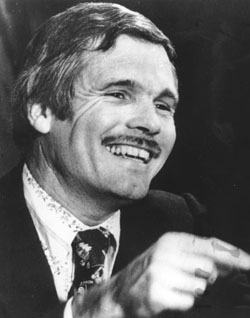
A proud maverick in all of his business dealings, Turner stayed in hot water with the Federal Communications Commission, which finally granted his wish to unload the radio stations so he could focus on the Braves. He had also purchased a failing UHF television station in Atlanta, and you could count the number of viewers on your fingers and toes. But he had a plan.
Turner viewed his team’s 162 baseball games as ideal TV programming. The stage was already set, and he figured by aiming the cameras at the action each day, he had a 3-hour daily TV show. The games were surrounded by old movies, and reruns of Andy Griffith and the Three Stooges. Never mind that the Braves were not very good, and 80 percent of the stadium seats were empty. Turner would fix that later. During one rain-soaked game, with the hapless Braves losing 10-2, acerbic announcer Skip Caray announced that during a delay, “We’re going to show you the antics of Moe, Larry, and Curly. I hope you’ll be able to tell the difference.”
The Braves soon became a contending team, and when Turner’s UHF channel became a national cable “Super Station,” they drew fans from coast to coast. Even today, when the Braves play in cities like Denver, Kansas City, or Miami, Braves fans often outnumber those of the home team. That is part of Ted Turner’s legacy. He had hired people who knew baseball to run the team. People who knew how to win. One of those was Bobby Cox, who died three days after Turner at age 84.
Cox was a third baseman when he played the game, but injuries hampered his performance. In just two years in the majors, he compiled a meager .225 batting average with only 9 home runs. By age 28, he was done. But a year later, the New York Yankees recognized his leadership skills and made him a minor league manager.
Turner lured him to Atlanta, where he piled up the 4th most wins in history. His arguments with umpires were legendary, and he will always hold the record for ejections with 162.
His players knew he “had their back.” They knew if they didn’t hustle, their new position would be “bench.”
As a lifelong Braves fan with a 3-month old grandson who is already wearing Braves gear, I appreciate Ted Turner and Bobby Cox. Thanks for the good times.